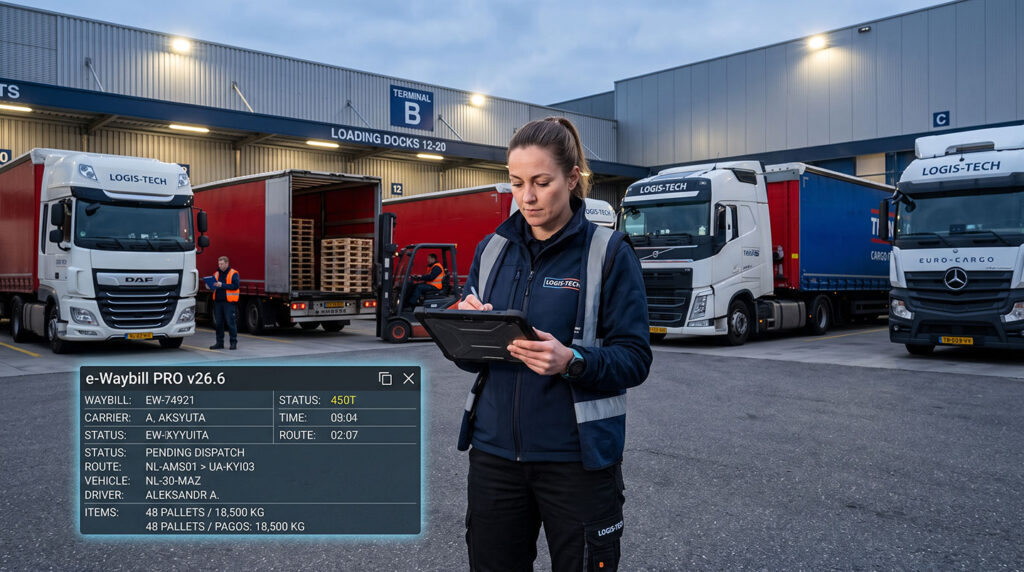
The era of paper transport waybills is coming to a definitive close. The State Information System of Electronic Freight Documents (GIS EPD) has become the central operational backbone of road freight logistics. The transition to Electronic Transport Waybills (ETRN) is no longer an optional digital trial — today it is a baseline commercial requirement for maintaining market competitiveness, eliminating tax audit risks, and accelerating document turnaround times.
Nevertheless, many supply chain stakeholders face practical questions: How does a driver sign documents on the loading dock? What happens when mobile signal is lost on remote transit highways? How do you seamlessly integrate your existing ERP/1C environment without disruption? In this comprehensive guide, the Aurus Logistic team provides clear answers to all operational and legal aspects.
ETRN Architecture: How the 4-Title Workflow Operates
An electronic transport waybill is neither a scanned PDF nor an unstructured spreadsheet. It is a strictly structured XML document formatted to state tax and transport standards, composed of four sequential stages (Titles). Each title is authenticated by specific digital signatures of the respective supply chain participant:
- Title T1 (Consignor / Shipper): Generated upon loading. Contains full counterparty details, cargo specifications, vehicle identifiers, driver information, and accompanying cargo certificates. Authenticated via Enhanced Qualified (QES/UKEP) or Non-Qualified (NES/UNEP) electronic signature by warehouse/shipper dispatchers.
- Title T2 (Carrier / Driver at Origin): Certifies physical acceptance of cargo for transportation, condition of seals, exact timestamp, and vehicle condition. The driver signs via a dedicated mobile app using a digital signature or simple e-key verified through the carrier system.
- Title T3 (Consignee / Receiver): Completed at destination upon unloading. Formally records goods acceptance, actual pallet count, gross weight, and any discrepancy acts or damage reservations (if identified).
- Title T4 (Carrier at Destination): Certifies final cargo handover to the consignee, completing the operational lifecycle of the shipment. Once executed, the waybill status is permanently closed in the central GIS EPD repository.
Roadside Inspections: Dynamic QR Verification & Offline Caching
A frequent operational concern among carriers and shippers is how traffic police (GIBDD) and transport oversight authorities (Rostransnadzor) conduct road checks without paper documents.
Upon completion of Title T2, the EDI operator automatically generates a unique dynamic QR code for the specific trip, accessible to the driver in their mobile application. Road inspectors scan this QR code directly with official service tablets to retrieve verified trip records instantaneously from the state GIS EPD database.
Crucial Operational Feature: Modern mobile solutions preserve the dynamic QR code and core consignment data in a secure, cryptographically verified offline cache on the driver’s device. Even in remote areas with zero cellular reception, traffic officers can verify shipment validity in local mode without delay.
Step-by-Step Corporate Implementation Checklist
✔ Step 1. Selecting an Accredited EDI Operator:
Contract with an officially accredited freight document operator listed in the Ministry of Transport registry. Ensure full multi-operator roaming support without hidden surcharges.
✔ Step 2. Issuing Electronic Digital Signatures (EDS) & MCHD:
Equip corporate executives and warehouse dispatchers with qualified signatures (QES) and Machine-Readable Powers of Attorney (MCHD). Configure mobile signing access for drivers.
✔ Step 3. Enterprise ERP & 1C System Integration:
nstall dedicated EDI modules or deploy native REST API connectors to generate electronic waybills directly from standard shipment orders in a single click, eliminating manual re-entry.
✔ Step 4. Staff & Driver Workflow Training:
Train dispatchers, dock workers, and drivers on practical handling: generating discrepancy acts, managing returns, and offline roadside verification procedures.
✔ Step 5. Pilot Dispatch & Full-Scale Rollout:
Execute 10–20 trial shipments on dedicated regular lanes with trusted partners to fine-tune signature timings before rolling out the system across all transport routes.
Economic & Operational Impact: Paper Consignment Notes vs. Digital ETRN
| Operational Dimension | Legacy Paper Consignment Notes | Electronic Transport Waybills (ETRN) |
| Original Document Return Cycle | 7 to 30+ days (courier, postal, driver delivery) | Instantaneous (within 2–5 minutes post-unloading) |
| Cost Per Document Set | 150 – 400 ₽ (printing, archive storage, couriers, loss) | 10 – 35 ₽ per transaction via EDI operator |
| Risk of Document Loss & Damage | High (leading to disputed invoices and delayed payments) | Zero (cryptographically secured immutable cloud archive) |
| Carrier Payment Settlement Speed | Delayed until physical signed papers arrive | Accelerated by 3–4x (significantly improving cash flow) |
| Tax & Regulatory Audit Verification | Time-consuming manual physical archive retrieval | Instant generation of verified XML registries in seconds |
Aurus Logistic is fully integrated with GIS EPD and provides end-to-end road freight solutions with automated electronic waybill processing. We guarantee legal compliance, rapid return of closing documents, and transparent real-time tracking across all cargo routes.
➔ Calculate road freight rates with ETRN: info@auruslogistic.ru | +7 (495) 181-67-75 | auruslogistic.ru/en/